Text by Joshua Cheek | Photos by Dhritiman Mukherjee

The hauntingly beautiful snow leopard has been immortalized in countless poems, myths, and artworks. It is one of the world’s most elusive and threatened big cats, with a habitat that spans more than 1.8 million sq. km. Snow leopards live in cold, dry, mountainous regions from southern Russia, all the way through Central Asia, to the Himalayas. In India, this shy, solitary creature lives in several national parks including Ladakh’s Hemis National Park, Namdapha National Park in Arunachal Pradesh, and Kibber Wildlife Sanctuary and the Great Himalayan National Park in Himachal Pradesh.

Snow leopard cubs are usually born in June or July, and live with their mothers until they are 1.5-2 years old.
Snow leopards are perfectly adapted for living in rocky inhospitable terrain. Their thick fur and small rounded ears keep heat loss to a minimum. Their large paws are covered with fur—creating natural snowshoes that provide additional traction for climbing, and are great for heat retention. Their fur—white, yellowish, or smoky-grey, patterned with rosettes and spots that are dark grey to black—is the perfect camouflage for their environment. They remain so well hidden that they have often been called mountain ghosts.
A few other unique features set snow leopards apart from other big cats—the length of their tails, the colour of their eyes, and the sound they make. Their tails are thick and long—nearly as long as the length of their bodies. This extra length helps them maintain balance when climbing steep slopes. Unlike most big cats that have yellow-gold eyes, the snow leopard’s eyes can range from light green and grey, to a piercing crystal-blue. Interestingly, they cannot roar like other big cats; instead, they make a purring sound that’s called a chuff.
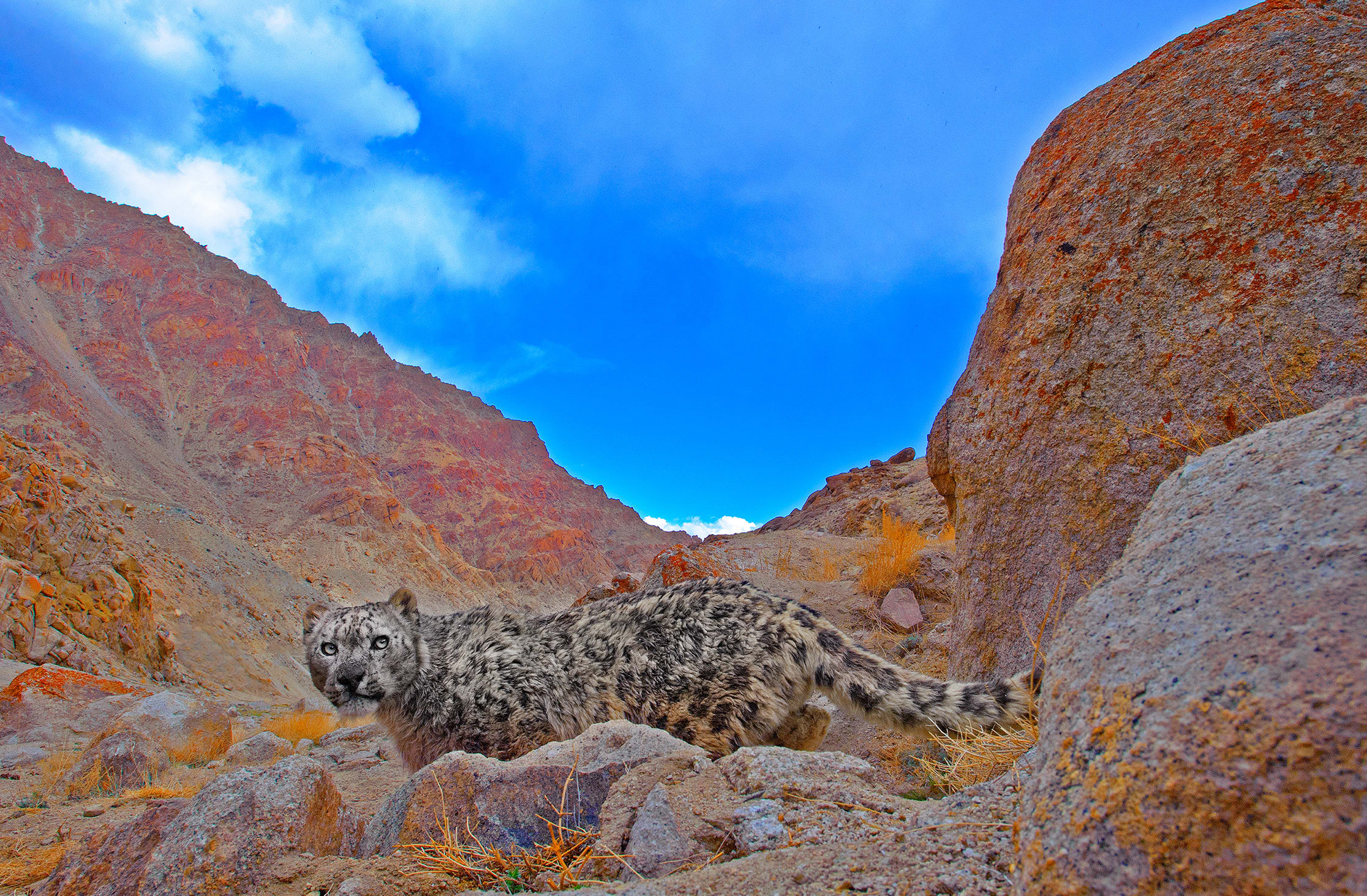
Snow leopards are gifted with night vision and eyesight six times sharper than that of humans.
The estimated worldwide population of snow leopards is in the range of 4,000-6,000, 60% of which is in China. In India the population of these high-altitude cats is estimated at 400-500. In September 2017, the International Union for Conservation of Nature(IUCN) moved the snow leopard from the ‘endangered’ list to the ‘vulnerable’ category. This means that the animals have gone from ‘very high risk’ to ‘high risk’ of extinction. This is good news, but these fabulous cats still need our protection, and much work remains to be done.

A snow leopard has powerful legs and can leap approximately 30-40 feet.
As the top predator of their environment, snow leopards prey on wild sheep (bharal and argali species) and the Asiatic ibex, whose increased populations could decimate the sparse vegetation of alpine regions, creating a chain-reaction of ecological deficits. However, snow leopards are also known to prey on livestock, especially during the harsh winter months. This has generated increased human-leopard conflict even in areas where they are officially protected.
Numerous worldwide programmes protect this species, which has been a victim of poaching and illegal trade. In India, no less than three different conservation projects and campaigns, from the Snow Leopard Conservancy Trust to Save Our Snow Leopards, exist to protect the species and its habitat. With diligence and conservation efforts extending throughout the vast territories in which they roam, these cats will hopefully soon land back on their feet.
SPOT THEM:
Spotting the snow leopard in the wild in India requires you to brave the bitter winter weather of Ladakh. A 5-6 day guided trip to the Rumbak Valley of Hemis National Park offers you the best chance for a sighting.


United States
+1 (425) 454-2113
1756 114th AVE SE
Bellevue, WA 98004
India
+91-11 39585644
IT C-7 KMG Tower
2nd Floor, Sector 67,
SAS Nagar
Mohali – 160062, Punjab