


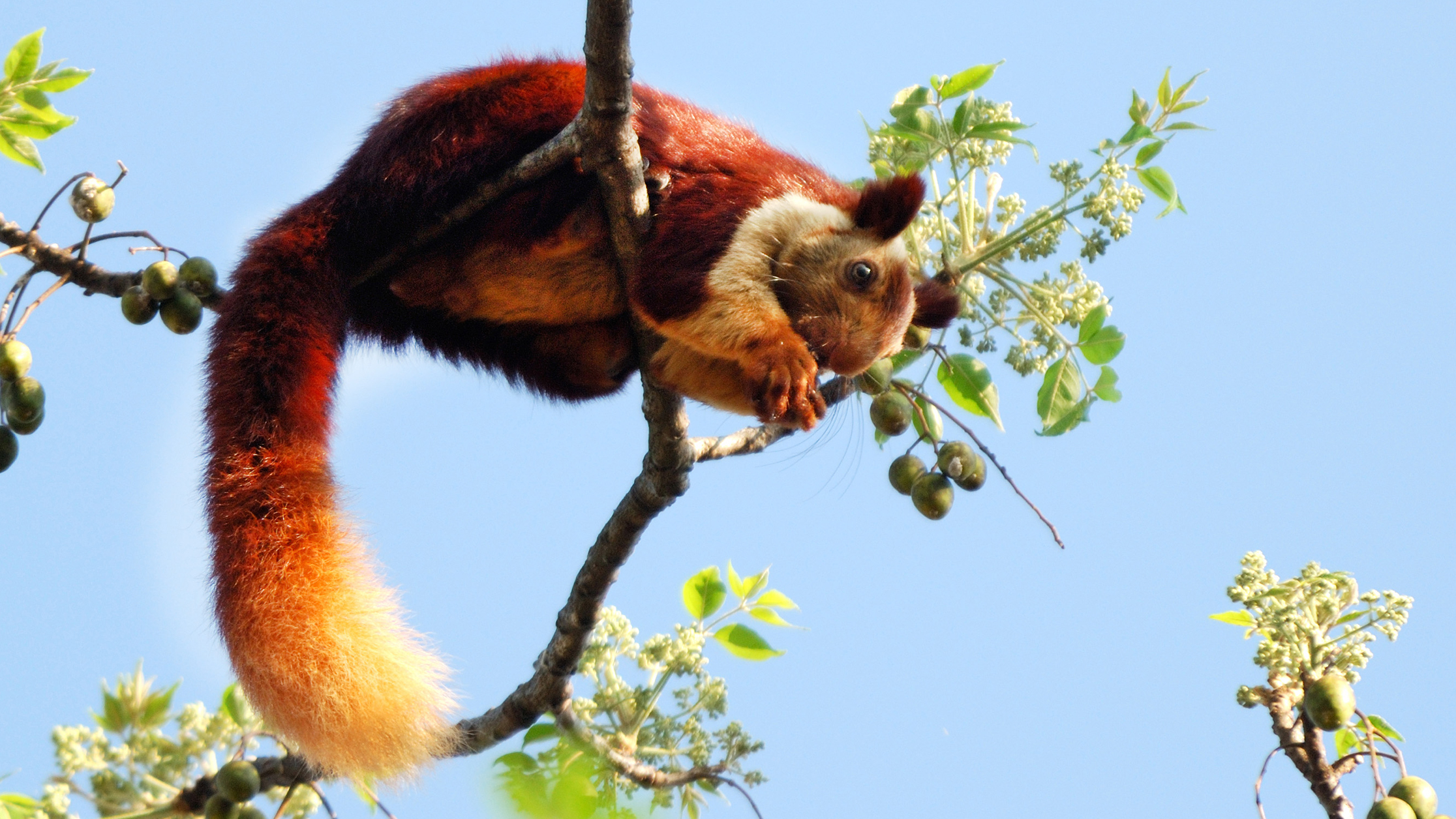
A Malabar giant squirrel looks like a bright ball of fur, topped with a tail that can be up to two feet long. Photo: Amoghavarsha
I was walking along a faint forest trail in Masinagudi in the Nilgiri Hills one early summer morning, hoping to catch a glimpse of any form of wildlife. The visitor in front of me suddenly squealed in excitement “I see something in that tree! It’s a red panda!” What she’d actually spotted was an Indian giant squirrel, also called the Malabar giant squirrel (ratufa indica). This unique squirrel species can be found deep in the mixed deciduous and evergreen forests of the Western Ghats, especially in the Malabar region, and is the state animal of Maharashtra.
The squirrel we were observing sat rather conspicuously on the branch of a teak tree, glistening in the morning sun. Our guide told us that these agile creatures spread their limbs and leap amazing distances—up to 20 feet—from tree to tree.

Amazing acrobats, these arboreal creatures can jump remarkable distances in the canopy. Photo: Sandeep Varma
Coat of Many Colours
Sporting gorgeous coats of long fur in burgundy, tan, rust, coffee, and buff, with creamy-beige underparts, giant squirrels are a treat to behold. Their lush tails can give a fox an inferiority complex. These squirrels are found in the ranges south of the Satpura Hills, and interestingly, each range group has evolved a different coloured coat. An enthusiast can recognise which region a Malabar giant squirrel comes from just from its colour markings. When they perceive danger, they have a peculiar way of hiding; they lie flat against the branch and freeze, hoping they’re not noticed. Some are known to quietly slide down tree trunks and slink away into the undergrowth.
Despite their size and brilliant hues, Malabar giant squirrels aren’t easy to spot, and their camouflage works very well. They’re sooner heard than seen, as their loud rattling call betrays their presence. Just like their urban cousins, the three-striped squirrel, Malabar giants are prompted to make repeated calls the moment they detect anything unusual. They raise an alarm, barking when a suspicious predator is spotted at a safe distance. Land-bound herbivores are ever grateful for this warning the squirrel provides, as it allows them to make a quick escape.
Shy Loners of the Canopy
Giant squirrels are active during the mornings and evenings, preferring to take a midday nap. The one we spotted was probably out foraging for food. They are shy animals who remain on high branches. They seldom venture to ground level as they are wary and cautious by nature. Instinctive precaution leads them to live and sleep in the upper canopy instead of the lower branches that predators can reach with ease.
Giant squirrels play a significant role in its local ecosystem by dispersing the seeds of the fruits they eat. As we only saw one during our time in Masinagudi, we wondered aloud where its comrades were. Our guide informed us that these squirrels are solitary creatures; they pair up only during mating season. They even go to the extent of building several circular nests on tall trees so they don’t have to share their space with their offspring.

Unintentional farmers, Malabar giant squirrels are significant seed dispersal agents. They drop seeds of the fruits they eat, which then sprout new trees. Photo: Murthy B.R.
The always-astonished expression on the face of this colourful squirrel, coupled with its short round ears, is an endearing sight. Just a few decades ago, Malabar giant squirrels were abundant in the forests of peninsular India, however, their numbers have dwindled considerably. While this is not yet a dire situation, there is cause for concern with continued habitat loss. A visit to any southern Indian forest is surely incomplete without sighting one of these arboreal beauties.
SPOT THEM:
The Malabar giant squirrel is commonly spotted throughout the national parks of the Western Ghats. Forests with tall trees are their favoured habitat. Bhimashankar Wildlife Sanctuary in Maharashtra, Mudumalai Wildlife Sanctuary in Tamil Nadu and Silent Valley, Wyanad Wildlife Sanctuary and Periyar in Kerala, among others, offer good opportunities for sightings.

United States
+1 (425) 454-2113
1756 114th AVE SE
Bellevue, WA 98004
India
+91-11 39585644
IT C-7 KMG Tower
2nd Floor, Sector 67,
SAS Nagar
Mohali – 160062, Punjab


