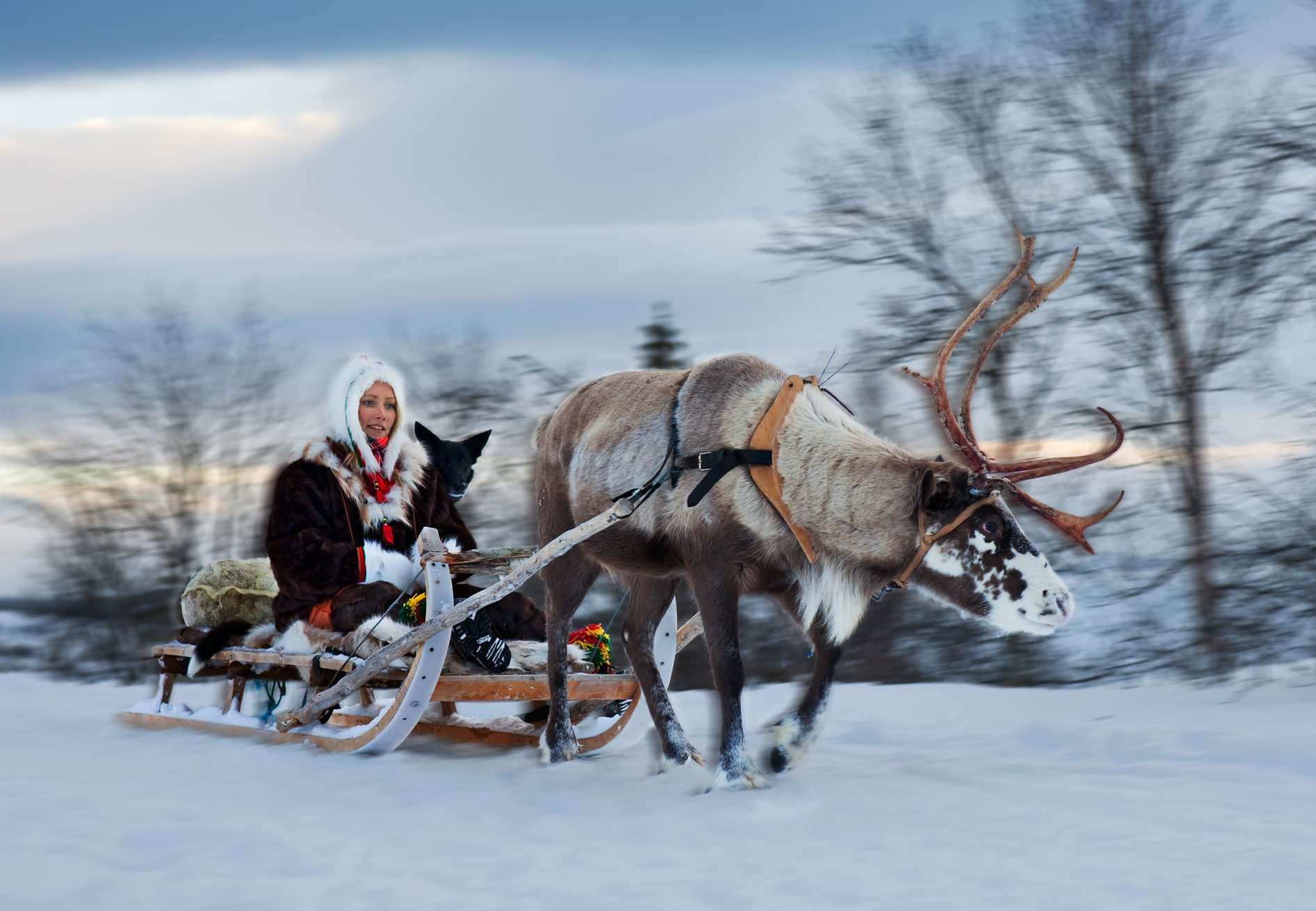
The Sami think of nature as a living being, one who is inextricably linked to their lives and welfare. Photo: Flickr/ Saamiblog
The Sami people of northern Scandinavia have 300 words for snow, each describing a different quality and condition of frozen ice. Oppas for instance, refers to snow that is untouched; skabrram, is a snowdrift, and habllek is Sami for the fine, powdery snow that is so loved by skiers. There’s also sievla (wet snow), skarta (thin snow) and ceavvi (a hard impenetrable layer that is best avoided).
The Sami language speaks volumes of the community’s connection to their habitat. The indigenous, semi-nomadic people have roamed the icy regions of northern Norway, Sweden and Finland for thousands of years, traditionally making their living by hunting, fishing and herding reindeer.
These are extreme conditions, where there is milky daylight from May through July, and darkness from November to February. It is rich in natural beauty—snow-capped mountains, wild rivers and pristine lakes—but it is also quite inhospitable for humans. For warmth, transport, and sustenance, the Sami relied on their reindeer, so much so, that many of the traditional Sami calendars are based on the life cycle of reindeer.
Today, of course, significant populations of the Sami are inducted into modern society. They are no longer nomadic, but their deep roots with nature remain. To us, the habitat of the Sami’s homelands might seem unchanged, but they know their world is shifting. They can tell by the nature of the ice, the strength of the winds, and the fish in the lakes.
The Arctic may seem an impenetrable icescape, but it is a fragile ecosystem, vulnerable to the changes our planet has seen in modern times. Harmony is the need of the hour: balance between new technology and traditional wisdom, between global and local, between our wants and our responsibilities as the apex species on our home planet.
There is a lot we can learn from indigenous communities, such as the gentle reindeer-walkers, as the Sami call themselves. By opening ourselves to a more intimate, respectful relationship with nature, regardless of where on the planet we live, we can save our habitat, and enrich our lives beyond measure. As the Sami people say, “all questions are environmental questions since the environment touches every aspect of their lives and surroundings.”


United States
+1 (425) 454-2113
1756 114th AVE SE
Bellevue, WA 98004
India
+91-11 39585644
IT C-7 KMG Tower
2nd Floor, Sector 67,
SAS Nagar
Mohali – 160062, Punjab